


For decades, denominations have experienced a slow-motion deterioration. The declines in any one year are subtle, but each year’s cumulative effects have become a serious problem. Why should we care?
Some look at denominations like the folding divider walls in a large room—unnecessarily compartmentalizing believers into theological camps and keeping them from uniting for the mission of God. There is some truth to this perspective. However, there are far more benefits to denominations than detriments. While denominations can become too insular, they provide an institutional foundation that no single organization or network can.
-
- Theological consistency and clarity
- Accountability for both pastors and churches
- Clergy benefits, such as health insurance and retirement
- Training, development, ordination, and licensing
- Financial resources for church revitalization and cross-cultural mission work
- Support networks and fellowship groups
In short, both pastors and churches have a trusted contact to call for solutions to a wide range of questions and problems. Are denominations necessary for the kingdom of God to grow? No. Can they be good for the kingdom of God? Yes.
Across the theological spectrum—from mainline to evangelical—denominations are shrinking. In this article, we look closely at the Southern Baptist Convention (SBC), the largest Protestant denomination in the United States, as a case study in what’s happening, why it’s happening, and what comes next.
Denominations Reflect Their Churches
Denominations don’t exist apart from their churches. They reflect the churches within them. When there are more healthy churches than unhealthy churches in a denomination, it’s healthy. It’s unhealthy when there are more unhealthy churches than healthy churches in a denomination. The problem most denominational executives face is that there are typically far more unhealthy churches than healthy ones. They are forced into triage leadership rather than strategic leadership.
When churches thrive, so do the networks that support them. When churches decline, those networks falter. For the SBC, the signs of struggle are everywhere: institutional downsizing, sex abuse scandals, weakening financial support systems, heated theological battles, and a shift away from evangelism as the central mission. But how big is the problem really?
The Scale of the Decline in the SBC
The first signs of trouble emerged in the early 2000s. I wrote in 2004 about the “striking plateau” of baptisms and the “inefficiencies” of our evangelism compared to previous eras. My father followed with another similar and more detailed report in 2005. These initial warnings were largely ignored, but the data and statistics were there. And the plateau we both saw became a precipitous decline.
According to research by Dr. Ryan Burge, the SBC has lost membership for 18 consecutive years. Membership peaked in the 2000s and has been on a steep slide ever since.
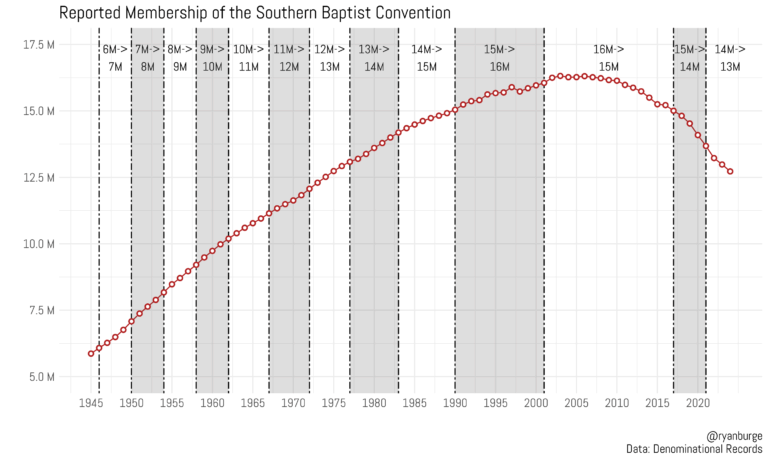
Some have commented, “we’re just cleaning up bloated membership roles,” but that’s not the case. It’s not a decline on paper. People are actually leaving. If “inactive” members are being removed from rolls, then the percentage of people who are “active” (attending weekly) should go up relative to the 2000s. Unfortunately, the opposite has occurred.
-
- Percent of SBC weekly attenders in 2024: 34%
- Percent of SBC weekly attenders in 2004: 37%
This decline isn’t from cleaning up inactive rolls. These are real people leaving the pews—and not coming back. Even though average weekly attendance has increased slightly since the pandemic low, it’s still over 30% below the peak and hasn’t recovered to 1980s levels.
-
- SBC weekly worship attendance in 1991: 4.6 million
- SBC weekly worship attendance peak (2009): 6.2 million
- SBC weekly worship attendance in 2024: 4.3 million
Perhaps the most sobering comparison is this: the membership losses the SBC has experienced in recent years are equivalent in size to entire mid-sized denominations. It’s not just a few churches closing; it’s a structural hemorrhage.
Evangelism: A Glimmer of Hope for the SBC
Baptisms are often seen as a marker of a church’s evangelistic health. In 2024, the SBC reported more baptisms than in 2019, the last full year before the COVID-19 pandemic. While this is a reason for optimism, it doesn’t erase the fact that the denomination still loses more members annually than it baptizes. Baptism numbers have dropped by more than 40% since the late 1990s and are 44% below the peak of the 1970s.
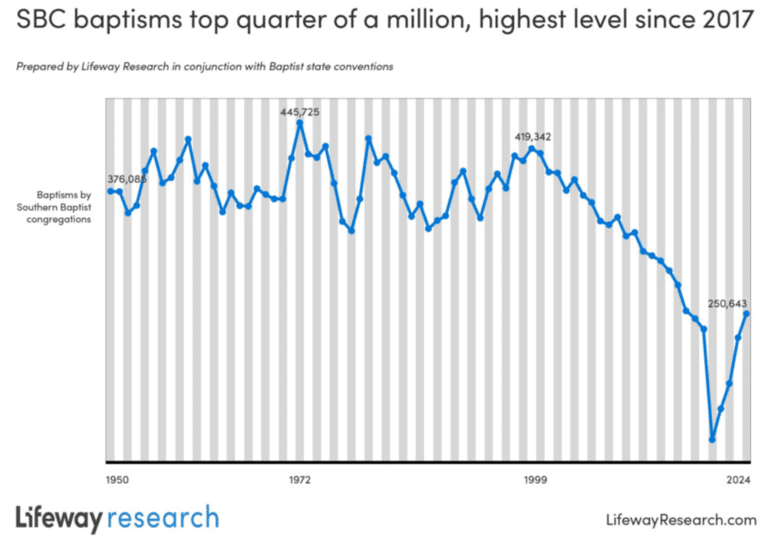
Is this recent growth in the last four years a genuine inflection point or merely a post-pandemic rebound? The answer remains unclear. One could surmise that a portion of the uptick in the previous few years was pent-up demand from pandemic church closures. What is clear is that the evangelistic engine that once fueled denominational growth is no longer firing on all cylinders. We have more churches and more money, but far less evangelistic energy.
Aging and Generational Disconnect
Another challenge the SBC faces is its age profile. While not the oldest Protestant group, the SBC lags behind in reaching younger generations. Even denominations like the Presbyterian Church in America (PCA), which has an older average membership, report more engagement from young adults. Again, consider this research by Dr. Ryan Burge.
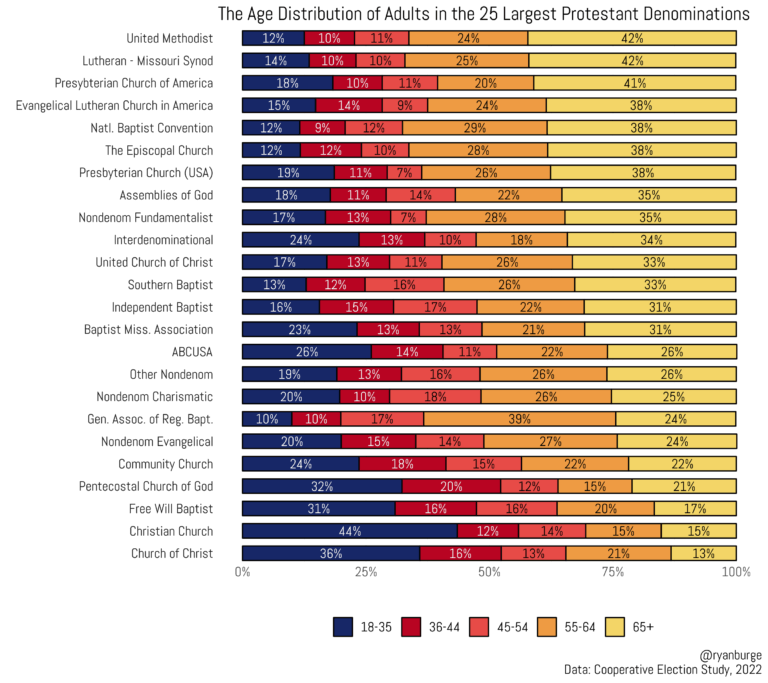
The SBC has one of the smallest representations of the two youngest age categories (18-35 and 36-44). Now, let’s consider a few facts here.
-
- The SBC grew in worship attendance from the 1980s to the early 2000s.
- At the same time, baptisms were declining rapidly.
- During this same period, the SBC was beginning to age quickly.
What do we make of these data points? The SBC expanded in the 1980s and 1990s primarily through Baby Boomer transfers from other denominations, not new conversions, and it never truly captured the hearts of the generations that followed, including our own children.
The Diagnosis of Decline
I’ve been surprised by the recent conclusion of some SBC leaders and commentators. Some of them claim that denominational decline is a kind of spiritual refinement, a purification process filtering out those who are not aligned. But that narrative sounds eerily similar to what mainline denominations said a generation ago as they experienced their own steep declines. When the desire to purify is greater than the desire to reach others, we’ve reached the point where the inward pull is greater than the outward call.
I believe more is happening than a simple purification process. A convergence of factors is creating a downward pull on the SBC.
-
- Worship attendance frequency: People fade before they leave entirely. When weekly attenders start coming every other week, your attendance declines by half. Though it’s difficult to know the precise impact of declining attendance frequency in the SBC, I believe it has dramatically affected recent years’ declines.
- Scandals and theological infighting: What makes the headlines does influence the broader public. Some will claim the recent negative headlines are unfair. Others will say it’s been a long time coming, and the SBC is getting exactly what it deserves. Whatever your position, the benefits of staying no longer outweigh the costs of leaving. So, people are walking away.
- Large churches and future trends: Some of the largest SBC churches have either been kicked out (e.g., Saddleback) or disaffiliated (e.g., Elevation). While the SBC is a denomination of smaller churches, more people go to the largest churches. When the largest churches leave the SBC, their statistics go with them. These churches account for a substantial portion of overall worship attendance and baptism figures.
In truth, declining worship attendance frequency, a string of sex abuse scandals, theological infighting, and the exit of prominent megachurches have converged and created an atmosphere not conducive to growth. So, what’s next?
The Continued Slow Deflation of the SBC
The SBC isn’t going anywhere anytime soon. And that’s the problem. Consider where you put your energy. You can work hard with good intentions on the wrong things. You can exhaust yourself in misdirected endeavors. The SBC expends a lot of energy (and financial resources) every year. Much of this work is done with good intentions by hard-working people. Perhaps the latest uptick in baptisms indicates that some of this work is beginning to pay off. I certainly hope so. The next three or four years will be revealing as to whether we’re seeing a true return to the focus of evangelism.
What the statistics demonstrate right now is that the SBC is still in a multi-decade decline. The metaphor is apt: the SBC is not imploding—it’s deflating, like a balloon slowly losing air. I don’t expect an explosion. Just a slow fade as the air continues to leak.
What’s happening in the SBC is not unique. Other denominations are experiencing similar trajectories. As institutional influence wanes, informal networks and local associations may offer some relational support, but they often lack the resources for widespread revitalization. The future may belong to regional bodies that can reassert denominational identity with strategic focus and missionary passion. Watch as state conventions in the SBC become more like mid-size and small denominations. If nothing changes, I expect more Cooperative Program funds will remain in the states and less will go to national entities. The funding pie is shrinking, and the fight over proportional pieces will only intensify. Meanwhile, non-denominational churches will continue to rise, and many existing SBC churches will quietly de-emphasize their denominational ties.
The story of denominational decline is not just about numbers—it’s about mission drift, generational gaps, and misaligned priorities. If the SBC and other denominations are to experience renewal, it won’t come through institutional preservation but through a grassroots return to evangelism and discipleship. The question is not whether denominations will survive, but whether they will still matter. And that depends entirely on whether they can reclaim their purpose and passion for reaching people with the gospel. The decline of denominations is reshaping American Christianity. Whether that reshaping leads to renewal or continued erosion depends on how local churches respond.
Posted on May 26, 2025
As President of Church Answers, Sam Rainer wears many hats. From podcast co-host to full-time Pastor at West Bradenton Baptist Church, Sam’s heart for ministry and revitalization are evident in all he does.
More from Sam



6 Comments
I was raised in a Baptist church until I went into the military and later became a member of a different denomination church. After 40 years
(the last twenty not attending) I walked into a local Baptist church on a Sunday morning and there was no resemblance at all to what I had attended before. Let’s be frank, I felt so out of place because I was the only man in the 175 people with a dress shirt, slacks and a tie. There were no hymn books in the pews they had been replaced by a ” praise and worship team” with drums, guitars and paino. The majority were dressed as if they were attending a casual event. If the Governor has requested a future visit to the church everyone there would be in suits and dresses. How much more should the Creator of the Universe be shown the ultimate respect and reverence than a man. I once had a pastor actually tell me,” God isn’t interested in what you wear He’s interested in your soul” amen but tell that to the preist of the Old Testament. The Missouri House of Representatives will not allow men legislators on the Chamber floor without suits and ladies in proper business dresses. Traditional approach to worship has transitioned into the Laodiceda era. Truth hurts.
Well written and thoughtout.
Hi Mr. Sam, I read your article on denominational decline on the CP site. What I came away with is that you feel chuches have gotten away from evangelism and discipleship. I have a different perspective.
First, let me say that I am a believer or Christ-follower. I was raised in a non-Christian abusive home. I came to know Him when I was 16. And was very involved in the church for decades… teaching SS, with my husband, working with the youth, my husband was a deacon, etc.
I don’t generally go to services now, and haven’t for a long time. I don’t consider what we call church today to be authentic– for more reasons than I can cover here. But I’ll try to share with you some of the main reasons (not in any order).
Our family moved a lot with employment. We ended up in various mainstream, conservative denominations (Non-denominational, SBC, PCA, etc.). Each had their own set of beliefs and practices. We also studied our Bibles ourselves. As a result, we don’t fit in any denomination. The morality of Christianity today is appalling to us. The filthy language “Christians” use! And the movies and shows they see and recommend! I read a fair amount. I am shocked at authors and speakers, prominent church leaders (who have important insight and encouragement to share) — they will refer to a movie to make a point. I can’t tell you how many times I’ve looked that movie up on IMDB and had to stop reading the parental guide because of the filth the movie contained. Once in awhile we visit a church. We always come home depressed and regret going. Services, to us, seem like scripted plays. Each one has a part. Everyone does what they’re supposed to, and then we go home. One could participate in church programs without even knowing our Creator. (And many have.) It’s amazing that people who are supposed to love Him… they’re together, singing about love for Him and how wonderful He is. There should be a bond between them. But when the SERVICE is over, if you are not in a social circle, you will leave without any real connection between yourself and people who are supposed to be your brothers and sisters. Most won’t even make eye contact. Those who are talking to eachother, are discussing trivialities. This seems strange given that we all sang to Him, talked about and to Him…
Many, if not all, of the churches we have been in have split. A year or so ago, we met a couple in our neighborhood who had a home group meeting in their house. We had several encouraging talks together when my husband and I would walk. And I visited the young mother a couple of times to encourage her with some difficulties she was having. They invited us to their gathering. We went. And really enjoyed the meeting. The only negative was that we were told they had two pastors in their group. That seemed important. One of those pastors made it a point to talk with us, which we at first took as friendliness toward us, like others in the group. But it became evident that he was making certain that we understood we could only continue coming IF we came to the Sunday services and specifically, were there for the main pastor’s sermons. So we never went back. And our neighbors were less friendly after that. I hope this doesn’t sound arrogant. I don’t feel arrogant… I have heard all the sermons that can be preached. And I don’t think sermons are helpful for anyone who has known God for a length of time. Every week there is a new lesson. This week I learn I should be more patient. So I’m trying to grow in that area. Next week, I learn I should love others more. So now I’m trying to do that. And the next week, there is something else….. In our opinion, it would be far more helpful to teach (and this can only be done mostly through relationship) God’s children how to walk with Him, how to hear Him when He speaks, what the books of the Bible are about, church history, how to handle everyday life, etc.
There’s so much more that could be said. I read a book (you will not like it or agree with it) “So You Don’t Want to Go to Church Anymore”. I want to emphasize that the book did not form or shape my thoughts. It did give clarity to them and help me see my church experience as a whole. It is fiction, so one must remember that when reading. But I believe it is an accurate picture of the institutional church today. I also believe the Sardis church in Revelation is another accurate description of the church today.
I write with a kind tone, and am not angry or bitter in any way. This is just a snapshot of my experience. I hope it will be of help to you to hear part of the story of one of those people who left the institutional organization, but who loves and walks with our Creator.
Kindly, Carolyn
Thank you, Jeff!
I’m beginning this comment by letting you know “I AM OLD SCHOOL”. I have been BiVocational Music staff in several churches over 35-40 years. The biggest decline in the churches that I see is the lack of excitement . I am not talking about entertainment or working the crowd up to a frenzy but the excitement of the gospel preached and sung and the involvement of the ordinary member.
I think. the decline of evangelistic choirs and the leading in worship, preparing the congregation for what is to come in the preaching of Jesus and Him crucified has declined to the extent of being in a curriculum oriented classroom that is presented by preachers that have chosen a vocation instead of called and anointed by God. It is no wonder that people stay at home with no commitment to their local church.
I love the old Hymns and I love the contemporary music that lifts the name of Jesus and His grace and mercy but I miss the fervor of congregational singing. There is something to be said when you go to church and get in the car to head home and all you can say is WOW what singing and the message was Wonderful and the altar was busy!! It is a shame and disgrace that you won’t hear that type of comment often anymore.
I was told by a church member in the last 2 weeks that his pastor said that ›”many churches don’t do that anymore” He had asked his pastor why they did not have an altar in the sanctuary and that was the answer. This was a Southern Baptist church.
Man, I hear you, Brother! I have a similar background as you, and based on your staff experience of 35 – 40 years, I believe you and I are in the same age group. While I’ve never been on the music staff of any church, I have been a volunteer, singing in various choirs since I was four years old, so what you have said above, hits me where I live! Like you, I like the traditional hymns and the contemporary songs that lift up our Lord and Savior, for sure, and, like you, I have noticed a decline in corporate worship enthusiasm as well. In addition to what has been addressed in Sam’s article above and what you say, I can’t help but wonder if part of the problem is the change in some terms. For instance, we have replaced sanctuaries with worship centers, and replaced altars with stages. I believe that that trend, while it may be more appealing to the younger set, it has diluted – and therefore, diminished – our concept of God’s sacred sovereignty. Do we ever spiritually “take off our sandals, for the ground on which we stand is Hallowed ground”? Instead of striving to meet God at His level, I am concerned that we are trying to bring Him down to our level. Thank you for your comment.